
Sciatica in Pasadena: How an Evaluation Can Help Identify the Source of Leg Pain
damage or dysfunction of the peripheral nerves, the network that transmits sensory and motor signals between the brain, spinal cord, and the rest of the body. When these nerves are impaired, normal communication within the body is disrupted, leading to a range of uncomfortable and sometimes debilitating symptoms. Patients may experience numbness, tingling, burning sensations, muscle weakness, or even loss of coordination, most commonly in the hands and feet.
At iSpine in Pasadena, CA, our goal is to address neuropathy with non-invasive, technology-driven treatments designed to relieve symptoms and restore function. By focusing on the underlying causes of nerve dysfunction rather than simply masking discomfort, patients can regain mobility, improve daily function, and enhance their overall quality of life.
Common Causes and Types of Neuropathy
Pain that travels from the lower back into the buttock and down the leg can be unsettling. It may feel sharp or burning, it may be accompanied by numbness or tingling, and it can make sitting, standing, or walking uncomfortable. Many people describe this pattern as sciatica, but sciatica is a description of symptoms rather than a diagnosis in itself. The same leg pain can arise from a disc, from narrowing of the spinal canal, from a slipped vertebra, or from muscles deep in the hip. At iSpine Health Center in Pasadena, Dr. Fadi Al-Selhi, DC, MS, DACNB, focuses on identifying the underlying source of symptoms before recommending non-surgical care, because a plan built on the actual cause is more likely to be appropriate than one aimed only at masking discomfort.
What Sciatica Is and Is Not
A clinical review in The BMJ describes sciatica as a common condition that is usually diagnosed through a careful history and physical examination, and notes that the term is used for leg pain arising from irritation of the lumbar nerve roots (Jensen and colleagues, 2019). Because different conditions can produce similar leg pain, the label sciatica tells us where symptoms are felt, but not necessarily why they are happening. That distinction is the reason an evaluation matters.
A Symptom With Many Possible Sources
A clinical review in The BMJ describes sciatica as a common condition that is usually diagnosed through a careful history and physical examination, and notes that the term is used for leg pain arising from irritation of the lumbar nerve roots (Jensen and colleagues, 2019). Because different conditions can produce similar leg pain, the label sciatica tells us where symptoms are felt, but not necessarily why they are happening. That distinction is the reason an evaluation matters.
How Sciatica Differs From Local Back Pain
Back pain that stays in the lower back is often related to muscles, joints, or ligaments. Sciatica, by contrast, involves pain that travels below the knee in many cases, and it may be accompanied by neurological symptoms such as altered sensation or reduced strength. Some people have both back pain and leg pain, while others notice leg pain with little back discomfort at all.
Common Causes of Sciatic Leg Pain
Our sciatica page outlines several conditions that may contribute to sciatic nerve irritation. Understanding them can help patients make sense of what an evaluation is looking for.
Disc Herniation and Bulging Discs
When the inner material of a spinal disc pushes outward through a tear in its tougher outer layer, it can press on or inflame nearby nerve roots. Disc herniation is one of the most frequent causes of sciatica. Our disc injury page describes how disc problems can affect the spine and surrounding nerves.
Degenerative Disc Changes
Over time, spinal discs can lose hydration and height. This can reduce the space available for nerve roots and contribute to irritation, particularly when combined with other age-related changes in the spine.
Spinal Stenosis
Spinal stenosis refers to narrowing of the spinal canal or the openings where nerves exit, often due to bone spurs, thickened ligaments, or disc changes. Symptoms may worsen with standing and walking and ease with sitting or bending forward. Our spinal stenosis page explains this condition in more detail.
Spondylolisthesis
When one vertebra slips forward relative to the one below, it can narrow the space for nerves and produce combined back and leg pain, especially with prolonged standing or walking.
Piriformis Syndrome and Soft Tissue Factors
The piriformis muscle lies deep in the buttock near the sciatic nerve. When it is tight or irritated, it may produce buttock pain and leg symptoms that resemble sciatica. Muscle imbalances, posture, and movement patterns may also contribute to irritation in some people.
How an Evaluation Helps Identify the Source
Because leg pain can come from several places, the evaluation is the foundation of care at iSpine Health Center. According to our sciatica page, diagnosis involves a clinical evaluation including physical examination and neurological testing, with imaging recommended if symptoms are severe or persistent.
History and Symptom Pattern
The process begins with a detailed conversation. When did the pain start? Was there an injury, or did it develop gradually? Which positions make it better or worse? Does it involve numbness, tingling, or weakness, and exactly where in the leg and foot? These details often point toward a particular source. Pain that worsens with sitting and bending may suggest a disc-related problem, while pain that builds with walking and eases with sitting may suggest stenosis.
Physical and Neurological Examination
The examination typically assesses posture, spinal movement, hip and pelvic mechanics, muscle strength, reflexes, and sensation in the legs and feet. Specific tests can gently stress the nerve roots to see whether symptoms are reproduced. Dr. Al-Selhi’s postgraduate training in functional neurology and his status as a Diplomate of the American Chiropractic Neurology Board, as described on his doctor profile, inform this neurological portion of the assessment.
When Imaging May Be Considered
Not everyone with sciatica needs imaging right away. Imaging may be considered when symptoms are severe, persistent, or accompanied by neurological changes, or when the findings will influence the plan. When imaging is appropriate, it is interpreted alongside the examination, since disc changes can be present on scans in people without symptoms.
Signs That Need Urgent Medical Attention
Our sciatica page notes that urgent evaluation is necessary if symptoms include significant weakness, loss of coordination, or bowel or bladder dysfunction. Numbness in the groin or saddle area, progressive weakness, or symptoms following significant trauma also require immediate medical care. In these situations, prompt referral is the appropriate step rather than conservative treatment.
Non-Surgical Care Options
Our sciatica page notes that most cases improve with conservative care, and that more advanced interventions may be considered if symptoms persist. Once the likely source has been identified, Dr. Al-Selhi develops an individualized plan that may include several of the approaches below. Responses vary from person to person, and the plan is adjusted based on progress.
Spinal Decompression
For some disc-related conditions, spinal decompression may be considered. This approach uses controlled mechanical traction to gently stretch the spine and may help reduce pressure on discs and nearby nerve structures. Suitability is determined through a clinical assessment, and decompression is not appropriate for everyone.
Class IV Laser Therapy
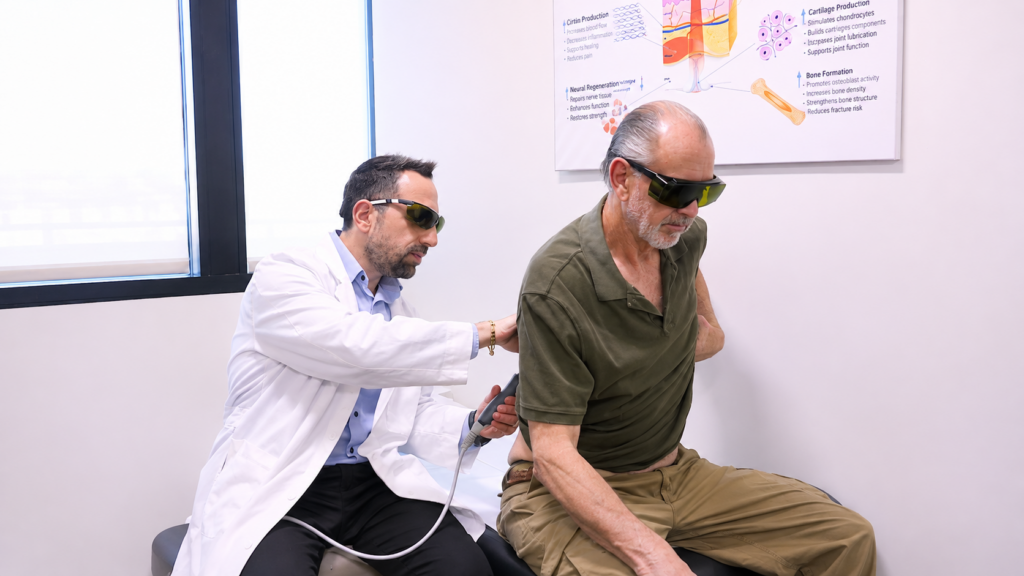
Our practice also offers Class IV laser therapy, which may be incorporated as a supportive part of care for some patients. It is generally used alongside other approaches rather than as a standalone answer.
Exercise, Posture, and Movement
Rehabilitative exercises, posture guidance, and ergonomic advice may help support spinal health and reduce strain during daily activities. The BMJ review by Jensen and colleagues emphasizes patient education and staying active as part of first-line management for sciatica, which aligns with an active, function-focused approach to care.
Additional Considerations
Some circumstances call for extra care in how sciatica is evaluated and managed, and a few practical habits can make the time before an appointment easier.
Sciatica in Older Adults
Leg pain in older adults deserves particular attention because the likely causes can shift with age. Degenerative disc changes, arthritis of the spinal joints, and spinal stenosis become more common, and symptoms may be influenced by balance, bone health, other medical conditions, and medications. Dr. Al-Selhi’s master’s degree in Gerontology shapes how he considers these factors, including how pain affects mobility, confidence, and independence. For older patients, an evaluation also looks at fall risk and the practical demands of daily life, so that any plan supports safe movement at home and in the community.
Everyday Habits Before Your Visit
While waiting for an appointment, many people wonder what they should and should not do. General guidance in the medical literature favors staying gently active within comfortable limits rather than prolonged bed rest. Changing positions regularly, taking short walks if tolerated, and avoiding activities that clearly provoke sharp leg symptoms are reasonable starting points. Keeping a brief record of when symptoms occur, which positions help, and whether numbness or weakness is changing can make the evaluation more productive. Anyone who develops the urgent warning signs described above should seek immediate medical care rather than waiting for a scheduled visit.
What to Expect Over Time
Sciatica often follows a variable course. Many people improve over weeks to months, while others experience recurring episodes or persistent symptoms. Setting realistic expectations is part of every plan, and progress is measured by function as well as pain, such as the ability to sit through a meeting, walk farther, sleep more comfortably, or return to a favorite activity.
When a Different Approach Is Needed
If symptoms do not respond to a reasonable course of conservative care, or if new neurological signs develop, Dr. Al-Selhi may recommend further imaging or a referral to a medical specialist. Non-surgical care is one part of a broader continuum, and coordinating with other providers when appropriate is in each patient’s interest.
About Dr. Al-Selhi and iSpine Health Center
Dr. Fadi Al-Selhi is a licensed Doctor of Chiropractic and the Clinic Director of iSpine Health Center in Pasadena. His profile describes more than 14 years of focus on helping patients, particularly older adults, manage chronic pain, improve mobility, and maintain independence through conservative care. He earned his Doctor of Chiropractic degree from Cleveland Chiropractic College, Los Angeles, holds a master’s degree in Gerontology, and has completed advanced postgraduate training in functional neurology. Every treatment plan is personalized according to the patient’s condition, health history, functional limitations, and goals.
Schedule a Sciatica Evaluation in Pasadena
Leg pain does not have to remain a mystery. A thorough evaluation can help clarify where symptoms are coming from and which non-surgical options may help support your recovery. If you are experiencing sciatic pain, Dr. Al-Selhi and our team at iSpine Health Center invite you to schedule an appointment to begin with a careful assessment.
References
- Jensen RK, Kongsted A, Kjaer P, Koes B. Diagnosis and treatment of sciatica. BMJ. 2019. PubMed: https://pubmed.ncbi.nlm.nih.gov/31744805/